
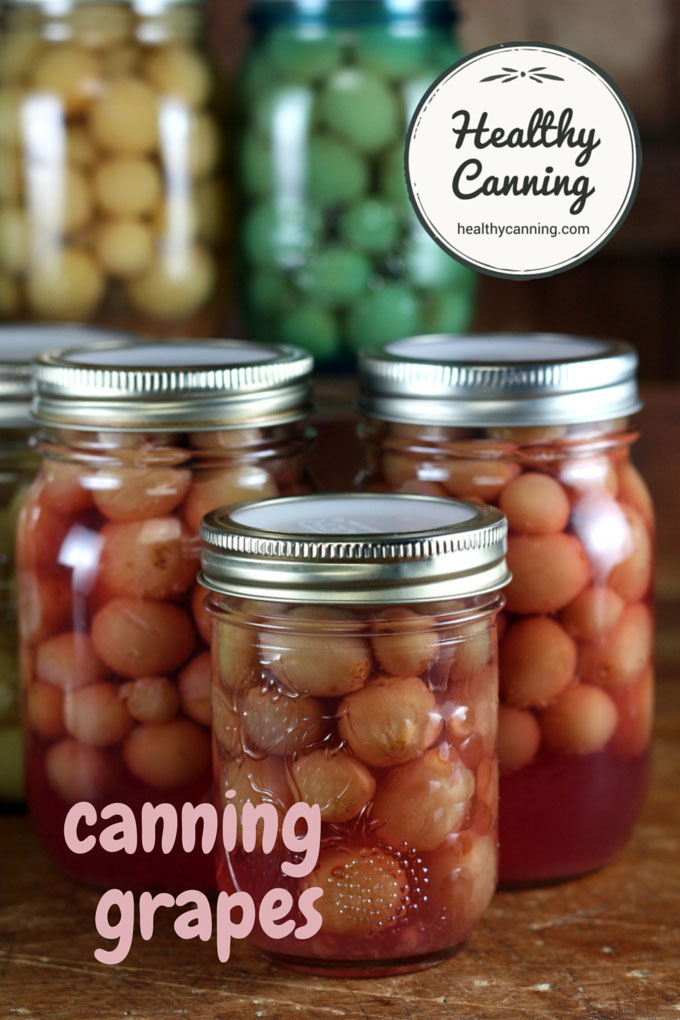
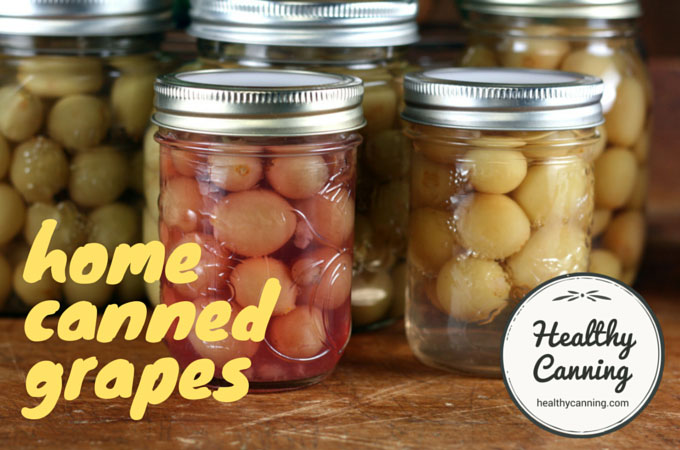
Home canned grapes have a delicious, wine-like flavour to them.
They are delicious spooned over a bowl of thick Greek yoghurt, or ice cream.
They are also good mixed with some pieces of fresh fruit (such as orange sections and banana slices) for a mixed fruit cocktail — use the juice off the canned grapes as a syrup. You can also use them in fruit salads or jellied salads.
Or, drain and use in savoury dishes such as “Grape, Celery, and Couscous Salad”, or “Pork Medallions with Roasted Parsnips and Roasted Grapes.”
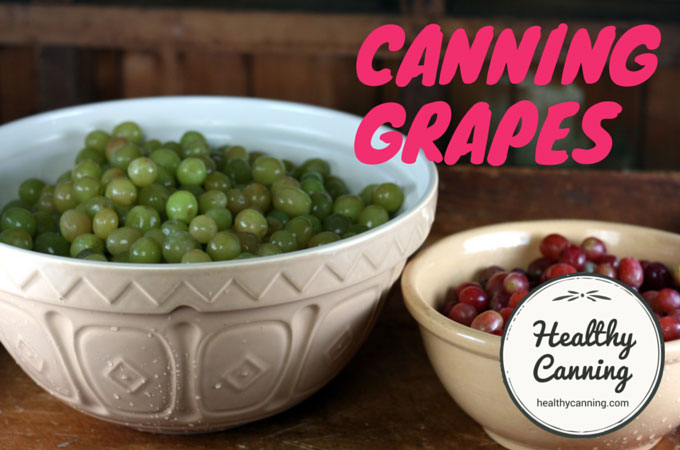
On this page, we work through the USDA procedure for home canning grapes. You may can these in plain water for maximum flexibility, or in sweetened water (see Sweetening Options below.) If you are using table grapes, you may well find they are sweet enough on their own as is.
To be clear, this is a procedure for canning grapes as fruit in their own right: not made into jam, jelly or juice, etc.
Note: Utah State extensions offers this tip about seeded vs seedless varieties: “Seedless grapes can be canned whole for use in fruit salads and molded gelatin desserts.
If seeded varieties are used, halve and remove seeds before canning.” [ref]Jensen, Christine and Charlotte Brennand. Grapes. Utah State University Cooperative Extension. March 2010. [/ref] Use the tip of a knife to get the seeds out (and discard them.)
Quantities of grapes needed
Numbers are approximate guidelines.
On average, as a very rough guideline, expect to need about 1 kg (2 lbs) grapes per litre (US quart) jar
- 6 kg (14 lb) of grapes = 7 litres (US quarts) canned grapes
- 4 kg (9 lbs ) of grapes = 9 x ½ litres (US pints) canned grapes
- 1 lug grapes = 12 kg (26 lbs) = 12 to 14 litres (US quarts) canned grapes
The recipe
If you are going to can these in a sugar syrup (see Sweetening Options below), prepare that first and set aside.
Jar size choices: Quarter-litre (½ US pint) OR half-litre (1 US pint) OR 1 litre (1 US quart)
Processing method: Water bath or steam canning
Yield: varies
Headspace: 2 cm (½ inch)
Processing time: 10 minutes, all jar sizes
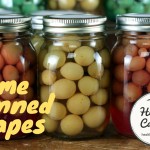
Canning grapes
Instructions
- Stem and wash grapes.
- Have a pot of water boiling.
- Add the grapes in small batches at a time so that the water will come back to the boil quickly.
- Let the grapes boil for 30 seconds, then fish out of pot immediately with slotted spoon or sieve.
- Repeat until all grapes are blanched.
- Divvy berries out amongst jars, leaving 3 cm (1 inch) headspace.
- Divvy blanching juice out amongst jars, leaving 2 cm (½ inch) headspace.
- If short of canning liquid, top jars up with boiling water from a kettle.
- Debubble, top up with more liquid as required to retain headspace.
- Wipe jar rims.
- Put lids on.
- Process jars regardless of chosen size from above in a water bath or steam canner for 10 minutes; increase time as needed for your altitude.
Nutrition
The USDA also gives raw-pack directions for canning grapes.
If you are canning the grapes in plain water, note that raw packs are not generally advised for sugar-free canning of fruit. Raw packs have a shorter quality shelf life; the sugar acts as a bit of a “fixatif” to help extend that a little.
Sweetening options
[Optional] To can sweetened. You can make a light sugar syrup, following the National Center’s directions for a light or very light syrup.
For sugar-free methods, we’ve had tasty sugar-free results using liquid stevia in the following proportions: Per quarter-litre jar (½ US pint), ⅛th teaspoon liquid stevia. Per half-litre jar (US pint), ¼ teaspoon liquid stevia. Per 1 litre jar (US quart), ½ teaspoon liquid stevia.
You may also wish to try Splenda ®.
Both would leave a clear liquid in the jar.
Some may ask about honey; the downside we can see is that honey could make the jar liquid “murky”; generally in home canning murkiness is relied upon as an indicator of something having gone wrong in the stored jars. Honey would also change the flavour.
Recipe notes
The small quarter-litre (1 cup / ½ US pint / 8 oz) jars are handy for baking; you may wish to can some of those jars unsweetened for maximum flexibility when you go to use them.
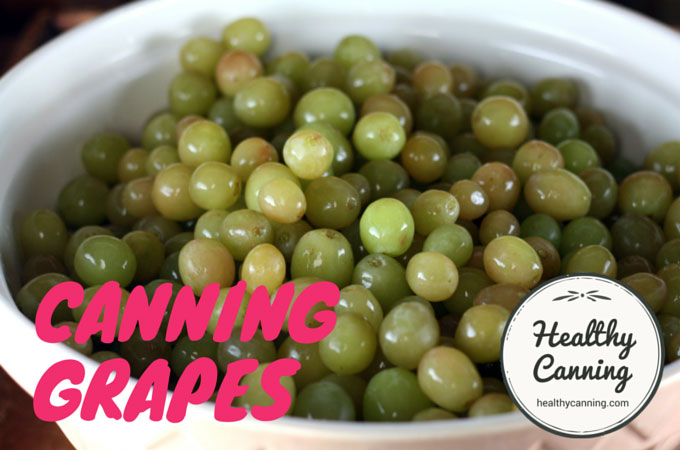
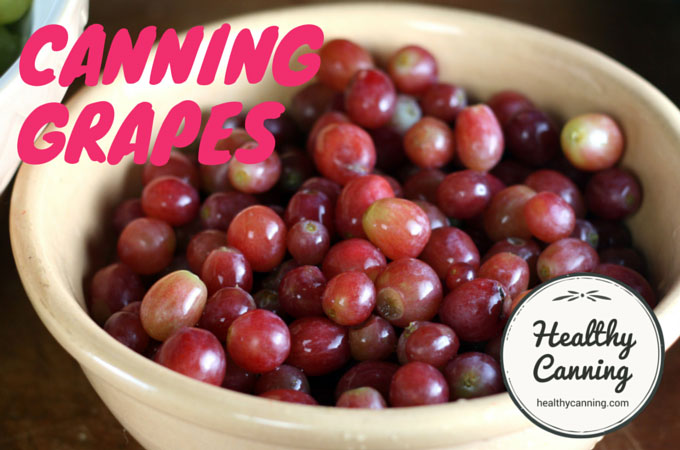
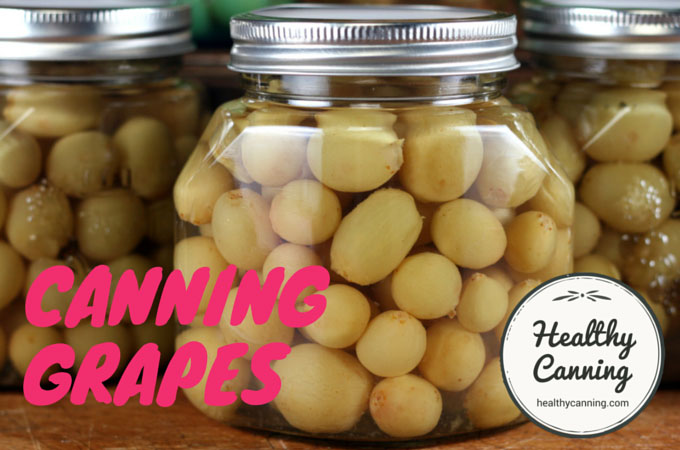
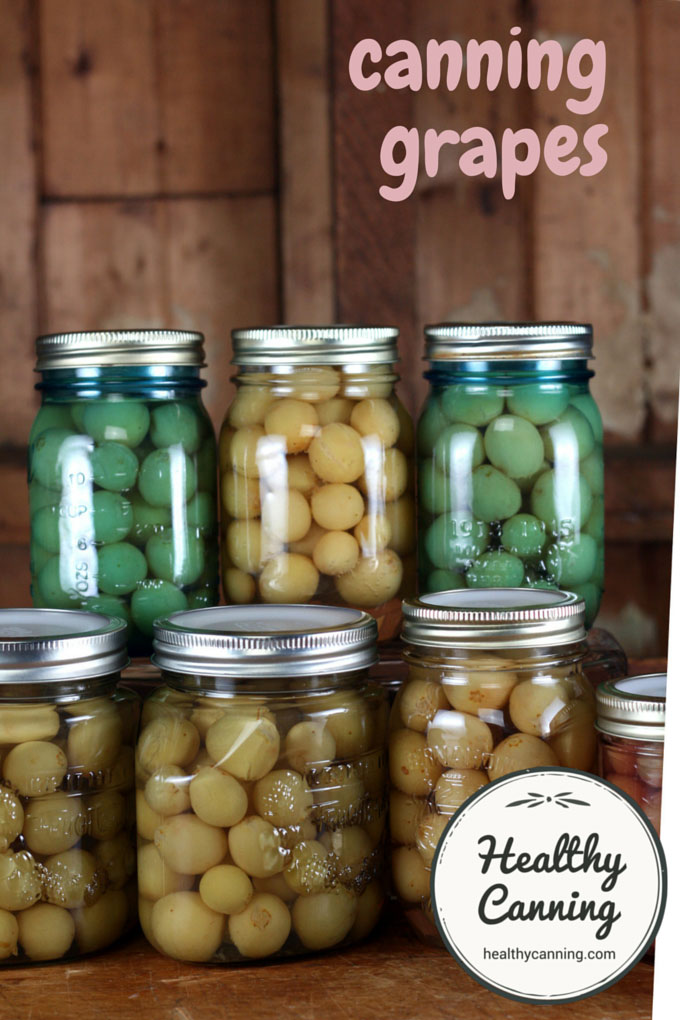
Note that both red and green grapes will lose their pronounced red and green colours respectively and end up very pale.
If you try to blanch too many grapes at once, the water will take forever to get back to a boil for blanching and your grapes may cook and turn to mush.
Reference information
How to water bath process.
How to steam can.
When water-bath canning or steam canning, you must adjust the processing time for your altitude.
For stevia, Better Stevia liquid stevia was the stevia used.
More information about Sugar and Salt-Free Canning in general.
What is the shelf life of home canned goods?
Recipe source
Grapes – Whole. United States Department of Agriculture (USDA). Complete guide to home canning. Agriculture information bulletin No. 539. 2015. Page 2-16.
Modifications: none.
Cooking with canning
Nutrition information
Serving size: quarter-litre (1 cup / 8 oz / 250 ml)
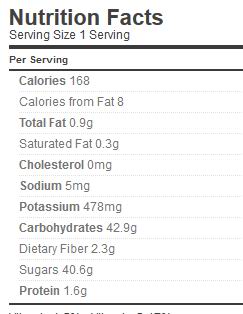
Per quarter-litre (1 cup / 8 oz / 250 ml): 168 calories, 5 mg sodium
Weight Watchers PointsPlus® and SmartPoints®: Per ¼ litre (1 cup / 8 oz / 250 ml): 0 points (grapes are free on Weight Watchers.)
* Nutrition info provided by https://caloriecount.about.com
* PointsPlus™ and SmartPoints™calculated by healthycanning.com. Not endorsed by Weight Watchers® International, Inc, which is the owner of both registered trademarks.
* Better Stevia ® is a registered trademark of the NOW Foods Company.
Stacy
Is it ok to increase the water to get more juice? So half a jar of grapes then filled to the top with water? I am more interested in the juice than the grapes.
Jim
Wow, Not only did I read this method of canning here, but I also read the official website. Boy, am I disappointed with the advertised and expected results? Over the actual results.
The photos in this article show grapes that are fully intact with no split skins or seeds on the bottom, and no floating grapes or peeled-off skins. That is what my jars looked like. I used the hot pack method as indicated in the official recipe. It tells you to boil the water with the sugar. Then add the fruit and return it to a boil. It did not say to add a small amount of fruit so I added all of the fruit at one time. Well, waiting for it to return to a boil took way longer than 30 seconds, more like 10 minutes.
I will say this, it isn’t a total loss since it made grape juice lightly sweetened with sugar. I wish I did not put the grapes in with the liquid. Now I’ll need to strain it before drinking.
Tell me, did you raw pack, or hot pack, if hot pack, how long do you wait one place reads, (30 seconds) another place said to return to a boil. Both methods on the official webs sight?
Healthy Canning
Hi Jim, sorry that happened to you. That’s why our directions here expound on the process a bit and add the advice, “Add the grapes in small batches at a time so that the water will come back to the boil quickly.” The jars in the photo were hot-packed.
Maria
My grapes split when I blanched them. How do I stop that and can I can anyway?
Healthy Canning
Yes, you can still can them. In fact, if they are seeded grapes, people may wish anyway to split them in half and remove the seeds. You could also use them for grape juice. Sorry, not sure why they split: perhaps other people will have some thoughts.
Kim
What is the consistency of the grapes after canning? Do they stay firm, or do they get mushy?
Healthy Canning
The varieties we have home canned have all stayed firm.
Kathy
Can I add brandy to the mix? That is to this recipe for water bath canning, not preserving only in brandy. I thought maybe I could add some sweetness and flavor if it would not compromise the canning. For instance, could I add maybe an inch of brandy to the jar and then fill the rest with the boiled water?
Healthy Canning
See here: Adding alcohol to home-canned fruit
Ann
Hi thanks for allowing me to ask your expertises on canning.
I have a question on grape canning in glass mason jars.
Someone gave me Recipe telling me to wash purple grapes leave a little stem on each grape put grapes in mason jar and fill with Brandy. That is all that needs to be done. Of course using sterile jars. But no other ingredient.
I trust the source but I’m saying does this sound right?
Thank you
Ann
Healthy Canning
We only trust and work with lab-tested recipes.
Me
When did people start canning grapes?
Healthy Canning
In 1917, Home Canning Recipes and Instructions, Butler Mfg, Kansas City, MO, gave the following directions for canning whole grapes (page 14): “The white grapes are better for ordinary canning than the purple ones, although the latter may be used. Wash, pick from the stems and pack. Fill jars with syrup and process.”
Nicholas Huynh
How Long do Canned Grapes Really Last?
Healthy Canning
The recommendation is, for best quality, use within one year. That being said, that’s a general recommendation that has to cover a broad range of storage conditions including the worst such as stuff in the light, in a hot place near a stove. If you store in a cool, dark place, your storage life will naturally be extended, and you’ll still have good quality. Note that the recommendation is not to discard after one year: instead, the intention is that those jars should be rotated to the front, so they’ll get used up sooner rather than later.